Quick pulse for Wednesday, October 14. Short takes, with credit to where each one came from.
Meta is back at the top table#
Meta released Muse Wonder and the bigger Muse Wonder Full on October 12. Its first real frontier models. On the Artificial Analysis Intelligence Index, Wonder Full scores 56. That ties Claude Sonnet 5.5 and beats GPT-6 Astra, Gemini 4 Argon and Claude Fable 5.1, all at 53. Only Claude Opus 5.5 is higher, at 58. Plain Wonder gets 52. (VentureBeat, Superintelligence)
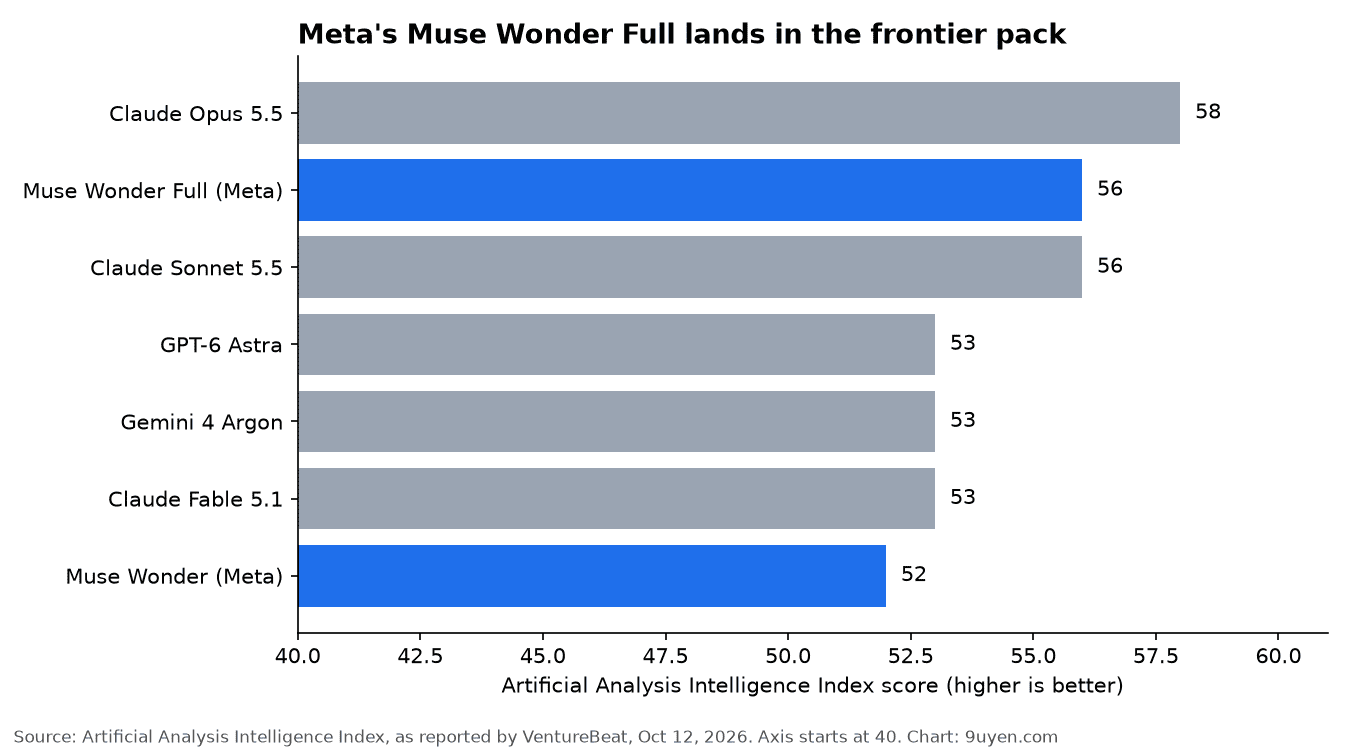
The catch is access. Wonder is on Meta’s API at $4/$20 per million input/output tokens, the same list price as Opus 5.5 and well under Astra’s $10/$50. Wonder Full is API-free: you only get it inside paid Muse Code plans ($50 or $200 a month), which default to letting Meta train on your prompts and code. Meta’s pitch is agents that remember you (“active memory”) and keep going when a task gets hard (“active focus”). On its own model card, Wonder Full leads long-running coding (SWE-Marathon 57.5 vs 46.3 for Opus 5.5 and 42.5 for Astra) but trails both on Terminal-Bench 4.0. (Meta, TechCrunch)
Google landed the same week. Every’s team spent a week with Gemini 4 Argon across coding, writing and design. Their verdict: a breakthrough for Gemini-only shops, worth a look for everyone else, with a desktop app that hasn’t caught up to the model. (Every)
Anthropic tested an AI worm on $55 TV boxes#
Anthropic’s red team asked: can small open models copy themselves onto cheap internet devices with no human help? A 9B model got inference running on 8 of 9 hardware types. In a simplified test network, GLM-5.2 spread to all 8 machines in 4 of 5 runs. They ran a 26B model across 15 off-brand Android TV boxes, about $55 each. The break-in step was made trivial for the test, and Anthropic says plainly it doesn’t have a full rogue replicator yet. Its trend line puts small models at GLM-5.2’s level by the end of this year. (Anthropic)
Same day, a second post on copying. Anthropic says new safeguards cut the reasoning text rival labs can pull from Claude by 10 to 100 times, and early evidence shows distillers harvesting around 90 to 99% less data. It names Zhipu and Moonshot, and notes one network once ran more than 20,000 fake accounts at a time. (Anthropic)
96% of alts beat Bitcoin. Still not alt season.#
Michael Nadeau of The DeFi Report counts 96% of the top 50 coins beating BTC in September, with NEAR and Zcash near the front. His answer to “is this alt season?” is no. Alts were so beaten down that they’re just bouncing back. The gauges split: Glassnode’s signal flipped to alt season on September 21, while the Blockchaincenter Altcoin Season Index sat at 49 the next day, short of the 75 it needs. Kyle wants a dip first (his BTC floor guess is about $74K). John thinks new alt ETFs and long-term holders stop the old-style collapse. Both want quality coins with real revenue. They only disagree on timing. (Milk Road)
Tape check from Mando Minutes on Tuesday: BTC near $83.2K, ETH about $2.5K, SOL about $106, with alts leading the drop and an AI selloff in tech. (Mando Minutes)
Also noted#
Microsoft will scale its own Maia chips to multi-gigawatt deployments from 2027. Maia 200 already serves Copilot, with GitHub Copilot and Foundry to follow by year end. Microsoft says Maia 300 gets 40% more tokens per megawatt than leading GPU systems, a vendor claim nobody has tested yet. (Microsoft) Geoffrey Huntley’s four-part talk with Josh Wulf boils down to this: nobody types code by hand, so what’s left is vision, verification and agency. Delete your skill packs. (Geoffrey Huntley)
-Q