Quick pulse for Thursday, October 15. Short takes, with credit to where each one came from.
Someone bugged OpenAI’s boardroom#
On September 30, OpenAI staff found a recording device wrapped in toilet paper and plugged into a USB port on the back of a TV in an executive conference room in San Francisco. The contents were encrypted. OpenAI says it used its own models to work out what the device was and who planted it. The FBI arrested engineer Abdulrahman Alfozan, 35, on October 9. He had worked there since July 2025. The complaint says a chatbot account tied to his spouse asked how to “build a continuous audio recorder” and “encrypt the SD card,” and a second recorder turned up in his bag. The charge is attempting to intercept oral communications, up to 5 years if convicted. It’s an allegation, not a conviction. (DOJ, OpenAI Newsroom on X)
Kim Isenberg at Superintelligence points out that AI 2027, the April 2025 scenario from Daniel Kokotajlo’s AI Futures Project, put lab espionage right around now. It warned that lab offices had “security more typical of a tech company than a military operation.” No government has been linked to this case. Washington is already treating it as national security: the FBI calls protecting American superintelligence work one of its “highest counterintelligence priorities.” (Superintelligence, AI 2027)
Claude writes so much code that Anthropic outgrew git#
Anthropic merged about 2,500 code changes a day in May. By September it was over 30,000 a day. Git became the bottleneck: main-branch history is almost 100 GB, and CI does around 25 million checkouts a day. So a team of seven built Scion, an in-house version control system for agents that are always online, and moved the monorepo onto it in five months. The new setup runs on 200x less CPU and memory than the old git mirrors, and checkouts take seconds instead of minutes. Every engineer on the team now rates Claude as a better coder than themselves. Their job is often to tell it “no.” Anthropic expects other companies to hit this wall within 6 to 12 months. (Anthropic)
Same week, Anthropic co-founder Jack Clark pulled his forecast for full recursive self-improvement forward a year, to 2027. One reason: on P-Zero Research’s new TasteVal benchmark, models’ research taste has doubled every 3 months since December 2025. Claude Opus 5.5 scores 2.30x the human-expert baseline, at about 1/30 of the cost per attempt. (Import AI)
Seoul’s memory panic#
Over the weekend CXMT, China’s biggest DRAM maker, said it plans to ship server memory on a denser 4F² cell design by the end of 2026. No specs, yields or volumes yet. On Tuesday the KOSPI fell 5.46% to 6,035.35, and a sell-side “sidecar” paused program trading. SK hynix dropped 10.09% and Samsung 7.39%. Together they’re about half the index. (Asia Business Daily, KRX notice, Technology.org)
This came days after Samsung guided to about 107.4 trillion won of Q3 operating profit, up 782.5% from 12.17 trillion won a year ago. That’s roughly a 55% margin on 195 trillion won of sales. (Samsung)
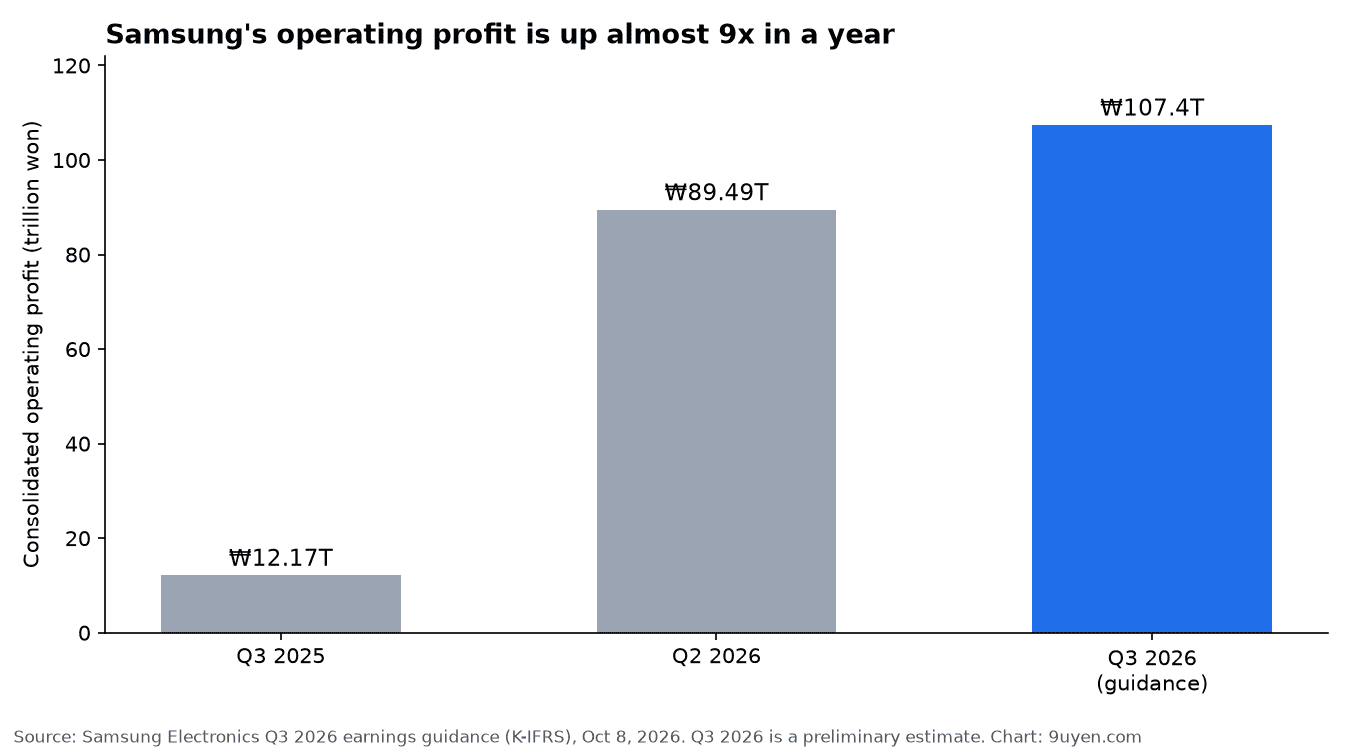
Source: Samsung Electronics Q3 2026 earnings guidance, Oct 8, 2026. Q3 2026 is preliminary.
Milk Road Stocks analyst Melvin calls the selloff an overreaction. Designing a chip isn’t making it at scale. HBM, the AI memory with the fattest margins, isn’t part of CXMT’s announcement. And Sandisk makes NAND, not DRAM. Elon Musk replied to him on X: once China learns to make something, it can often outproduce everyone else combined. Even Musk thinks the newest HBM will be harder to crack. So both see HBM as the moat. They disagree on how much the rest of memory still matters. What settles it: whether CXMT ships in volume by year-end, and Samsung’s full Q3 results with HBM detail, due October 29. (Milk Road Stocks, Reuters via Investing.com)
A coin that wants AI to mine it#
Pearl went live on April 27. It’s Bitcoin’s code with a different mining puzzle: matrix multiplication, the same math AI models run. So a GPU serving AI can mine PRL at the same time. Milk Road says PRL is up about 195% in 30 days, roughly 7x from its July lows. The best proof so far is Together AI, which launched a Pearl-powered Gemma 4 endpoint priced more than 25% below standard, paid for by the PRL it mines. (Milk Road, Together AI, Pearl Research Labs)
The holes are big. A June study of 8,012 miners found the main mining software did no AI work at all, and co-founder Omri Weinstein admits spam mining will always be possible. By Milk Road’s count, about 1M new PRL hit the market every day (about 89% new supply in a year, versus about 0.82% for Bitcoin), and two pools found 78.5% of blocks in a day. Spot trading happens on just two small exchanges. And the token has no burn and no revenue share. Milk Road’s call: the most interesting money story in AI crypto, but dilution is the near-term risk. (Milk Road)
From James (InvestAnswers)#
Four posts James (InvestAnswers) put up on Patreon last night, in my words.
A Tesla-SpaceX deal by Christmas? Barclays analyst Dan Levy wrote that a merger could be announced before Tesla’s annual meeting, which has to happen by December 6. James thinks it’s probably an informed guess that Watcher.Guru made sound like news. He still sees reasons Levy could be right. A deal this big needs a shareholder vote, and the annual meeting is the natural place for one. The market already widely expects it. And the two companies already work together a lot. Barclays itself says an announcement that slips into late October or November would make a vote at the meeting harder. (InvestAnswers, Business Insider, Yahoo Finance)
The token price gap. James’s point: the top US models cost far more per word than the cheap Chinese ones. The list prices check out. Per million output tokens (roughly 750,000 words), Anthropic’s Claude Fable 5 costs $50 and OpenAI’s GPT-5.5 costs $30. DeepSeek’s V4.1 Flash costs $1.20 ($0.60 off-peak), and Xiaomi’s MiMo-V2.6-Pro costs $0.87. James calls it about 50x. On list prices it’s roughly 40x to 57x against Fable, depending on the model. (DeepSeek’s bigger V4 Pro costs more, $3.96 at peak.) He doesn’t think a gap like that can last. His comparison is Ethereum vs Solana: one wins on brand, the other on cheap usage, and cheap usage exploded. (InvestAnswers, Anthropic, OpenAI, DeepSeek, Xiaomi MiMo)
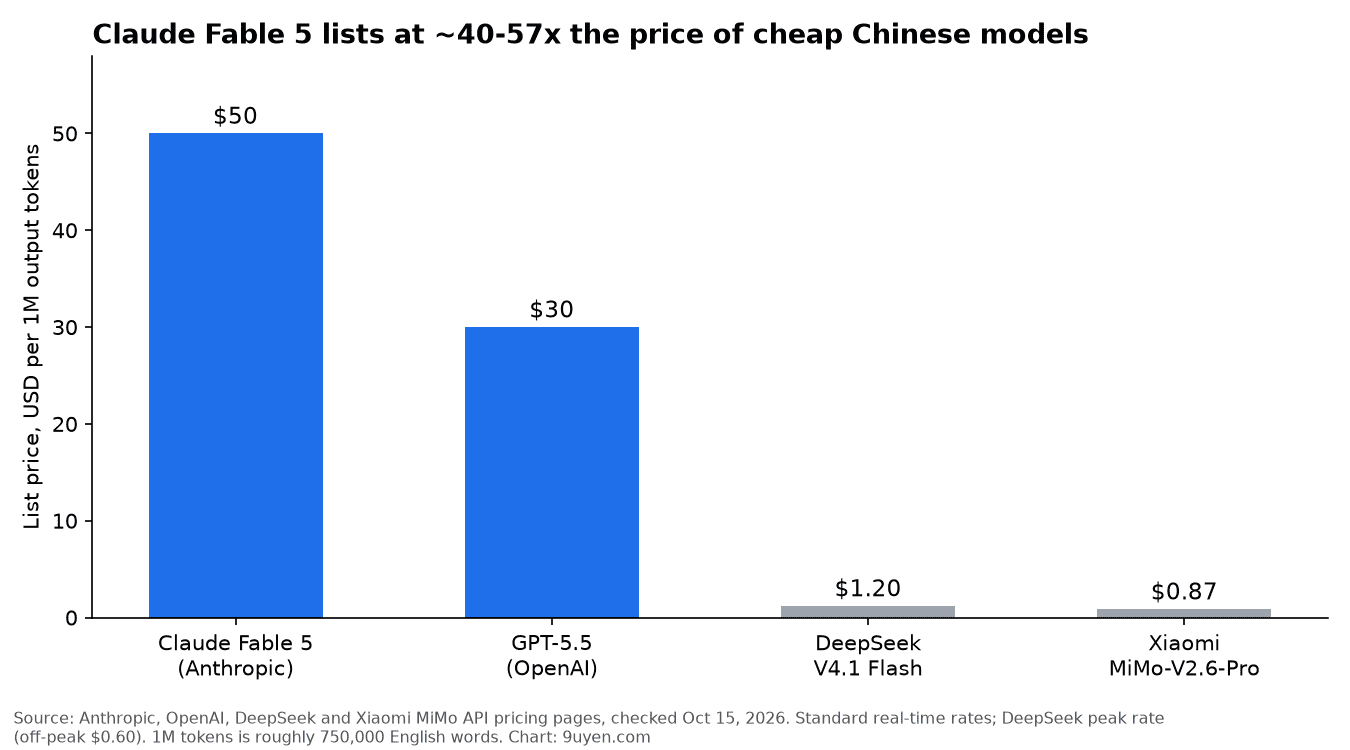
Source: Anthropic, OpenAI, DeepSeek and Xiaomi MiMo API pricing pages, checked Oct 15, 2026. Standard real-time rates; DeepSeek at its peak rate.
Arm wins on count, loses on price. On October 13 a Delaware jury found that Arm breached Qualcomm’s architecture license and interfered with Qualcomm’s relationship with Meta. The damages: $1 per claim, $2 in total. Arm won the other four claims, under the technology license and on good faith. InvestAnswers has ARM down 5.0% to $242.62 that day anyway. James’s read: the market isn’t pricing the $2. It’s pricing the risk to Arm’s royalties and its customer relationships. (InvestAnswers, CNBC, SDV Sector)
Starship wants 18x the launches. The FAA is starting an environmental review of SpaceX’s plan for up to 456 Starship launches a year from Starbase. Today it’s allowed 25. A first phase would allow 100. Public comments are due November 30. Flight 15 still flies under the current cap. InvestAnswers has SPCX as low as $152 that day. (InvestAnswers, Federal Register, Teslarati)
Also noted#
FeanixBio, a 28-person cattle-genetics startup in California, runs several agents in Slack next to its staff. Rumen answers questions down to a single cow, Linear’s agent turns threads into tickets, and the Every Agent flags problems before they snowball. The catch was cost. During the beta, CEO Mitchell Angove went back to working his tickets by hand. Every says the agent’s token spend is down about 60% since Opus 5.5 shipped in September. (Every) Geoffrey Huntley is turning off pull requests on his future projects. His “remix model”: publish the source and the intent, and let people change it with a small Nix overlay instead of a fork or a PR. The author owes no review. (Geoffrey Huntley) On Robinhood Chain, 0xSammy counts average daily DEX volume down about 61%, from $2.29B in the first half of September to $897M last week. Standard’s answer is a launchpad that pairs new tokens with stock tokens, with $1M+ in USDG rewards. (0xSammy, Standard)
-Q