Quick pulse for Sunday, October 18. Short takes, with credit to where each one came from.
AI debt has its telecom moment#
The CoreWeave week is in the books. The stock fell every day except Thursday and lost about a quarter of its value from the prior Friday’s close, per CNBC. It dropped nearly 12% on Friday alone. The Nasdaq lost 4.5% on the week.
The bond market is the scarier part. CoreWeave’s five-year default swaps sit around 1,000 basis points. Per Reuters, citing LSEG data, that prices a roughly 63% chance of default within five years, up from about 30% a year ago. Rates made it worse. September CPI came in at 3.7% against 3.6% expected, and the 10-year Treasury yield briefly hit 5.33% on Wednesday, close to a 24-year high.
Jensen Huang tried to calm things in Stockholm on Thursday: “CoreWeave’s strength is improving every day. I’m optimistic. Their cost of capital is actually decreasing.” He said Nvidia doesn’t need to backstop it. But Nvidia already owns about 10% of CoreWeave, sells it the chips, and under a 2025 order is obligated to buy any unsold CoreWeave capacity through April 2032.
That’s why Superintelligence’s Saturday deep dive says this looks more like the 2001–02 telecom bust than the dotcom crash. Dotcom wiped out shareholders. Telecom fell on bondholders and on the equipment makers that had lent money to their own customers. A supplier that owns its customer and promises to buy back its capacity rhymes with the second one.
Gartner: $3.5T of AI spending could be written down#
On Wednesday, Gartner put numbers on the fear. AI providers will spend nearly $1 trillion on infrastructure this year and another $6 trillion from 2027 to 2030. To cover that, plus financing and a 12% return on capital, AI data center owners would need $8.5 trillion in revenue through 2030. Gartner forecasts no more than $3.6 trillion of AI revenue they can claim. The gap leaves more than $3.5 trillion exposed to write-downs by 2030.
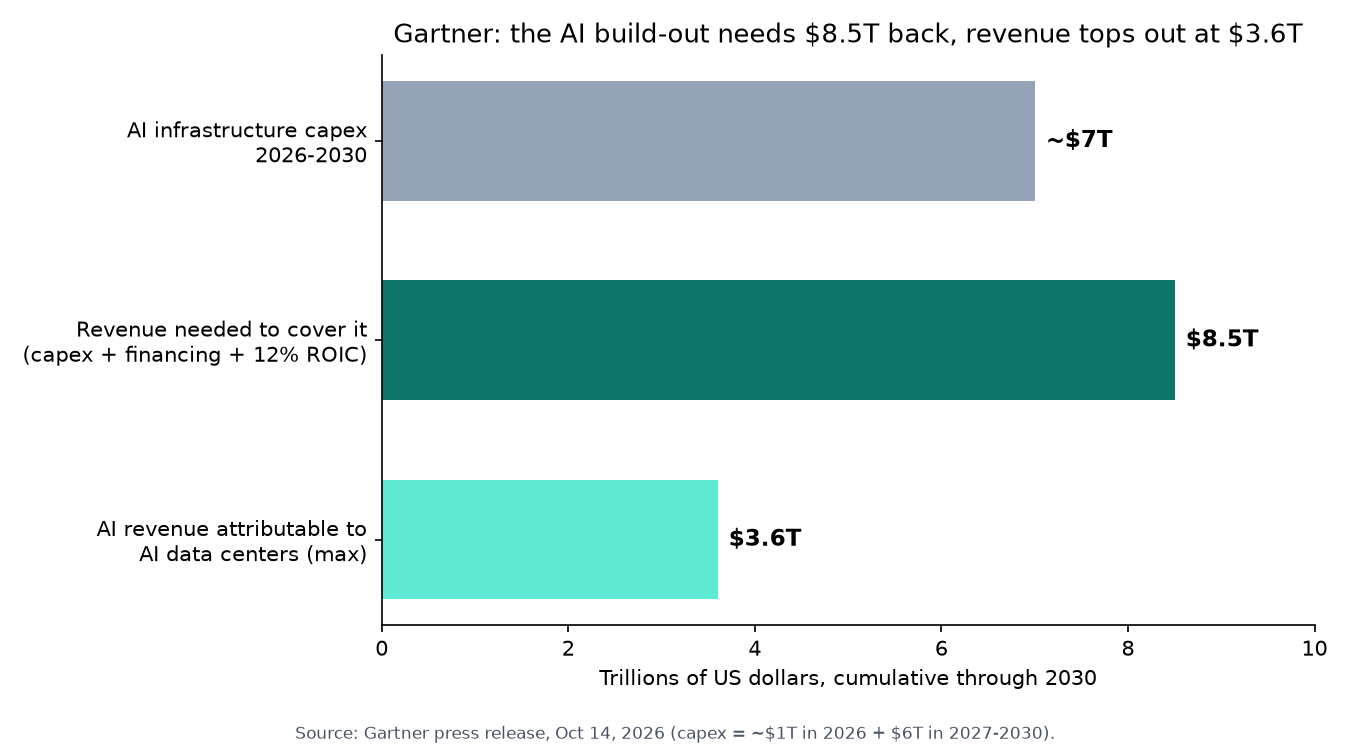
Source: Gartner press release, Oct 14, 2026.
Neoclouds like CoreWeave are the most exposed. Gartner expects more than 80% of them to stop operating independently by 2030. That includes being bought or merged, not only failing. The chip selloff had started a week earlier, when the FT reported OpenAI’s annualized revenue at about $50B, not the $70B reported in September. No sales went missing. The $70B counted roughly $20B of cloud-partner sales the way Anthropic books them. The Philadelphia chip index still shed about $1.64 trillion in six sessions, per Reuters.
levels.io hedges with T-bills#
Pieter Levels moved from nomad sites to AI apps in late 2022. Now he’s pivoting again, toward whatever moats AI companies can’t absorb. His list is concrete:
- Data: a paid nomads.com city-data API for companies at $2,490–$9,990 a year, with a hoodmaps.com API next.
- Network: the nomads.com community went from $99 to $1, just enough to stop spam.
- Distribution: about $15K a month from X, plus 187,279 email and Telegram subscribers.
- IRL and hardware: 8 meetups in the next 30 days, a “Longevity Hotels” filter on hotelist.com, and a 1990s retro PC mini under pieter.com.
- Capital: he’s holding the SpaceX stock he got when SpaceX bought Cursor. As a hedge “in case the AI bubble pops,” he added to IB01, an ETF of US Treasuries maturing within a year. He’s also looking at coastal land and is open to buyers for photoai.com and interiorai.com.
He skips regulation entirely. He doesn’t like it.
InvestAnswers#
James’s latest Patreon posts, in short. These are his reads, not advice.
The backlog is signed. James calls the AI bubble call nonsense and points to signed contracts. In their latest SEC filings, Microsoft, Oracle and Alphabet report about $1.87 trillion of remaining performance obligations between them: revenue customers have signed for that hasn’t been booked yet. It reads as a direct reply to Gartner: contracts, not forecasts. Two caveats: not all of it is AI, and it gets booked over several years. A backlog is also only as good as the customer behind it. Oracle doesn’t break its number out by customer, but OpenAI’s reported $300B Oracle deal from 2025 would be a big slice. CoreWeave just showed what markets do to a concentrated backlog funded with debt.
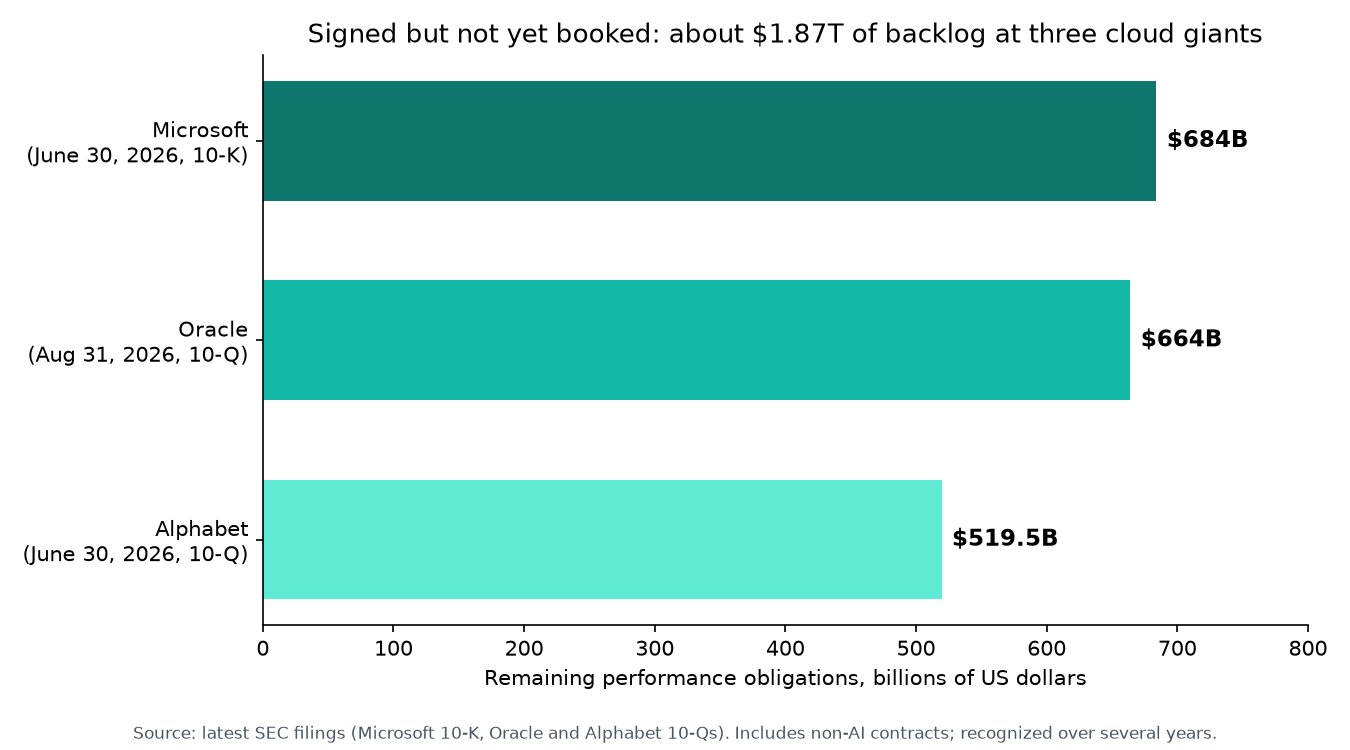
Source: Microsoft 10-K (June 30, 2026), Oracle 10-Q (Aug 31, 2026), Alphabet 10-Q (June 30, 2026).
Sold out past 2028. On this week’s All-In, Ben Horowitz said Andy Jassy told him Amazon is sold out until the end of 2028, maybe longer. That’s a secondhand account of a private chat. Jassy’s own words on Amazon’s Q2 call were more careful: not enough capacity for 2026 or 2027, and demand already booked for 2028 is “striking.” Horowitz’s point is the bull case against the telecom comparison above: the dotcom bust had too little demand, and AI has too little supply. Either way, someone carries the debt while it gets built.
Oil and rates pile on. Brent touched $110 on Friday for the first time since May, per Reuters, on Middle East and Russian diesel supply fears. Barclays now expects quarter-point Fed hikes in both December and January. Before, it expected only December. James reads that as more deficits and more money printing ahead. For AI borrowers, higher rates are exactly what made the CoreWeave week worse.
He bought the dip anyway. The Nasdaq 100 had its worst week since the April 2025 tariff shock and closed 7% below the high it hit ten days earlier. James says the bargains aren’t as deep as they were in April 2025, but what he did was buy three times during the week. Monday is the anniversary of the 1987 crash. He thinks a rough day is possible but not a repeat, with circuit breakers in place and cash on the sidelines. Next up: SpaceX reports Tuesday after the close, Tesla on Wednesday.
STRC goes daily. Strategy declared conditional daily dividends on STRC for November, at the same 12% annual rate. STRC pays twice a month now. If MSTR shareholders approve on Oct 28, it pays every business day starting Nov 2. If they don’t, the Nov 15 payment goes ahead as usual. The total paid doesn’t change, only the timing.
Also noted#
Geoffrey Huntley says OpenAI’s capacity falls apart when Europe wakes up. He’s met walls of “model is at capacity” errors from his machines in Germany for the past month, and even OpenAI’s Tibo posted that “it’s the compute that is cooked.” His fix is three open-source pieces. Underclass pools several ChatGPT subscriptions behind one OpenAI-compatible proxy and keeps prompt caches warm. Preflight scrubs secrets from requests before they reach a model. The new, experimental geoclass retries capacity errors from VMs in other regions over a Tailscale network. Read OpenAI’s terms before you copy the setup: they bar circumventing rate limits or restrictions.
-Q
Sources#
CNBC on CoreWeave’s week · Reuters on CoreWeave’s debt · Reuters factbox on CoreWeave · Bloomberg on Huang · Yahoo Finance on Huang and Nvidia’s stake · CoreWeave 8-K on Nvidia capacity order · Quartz on September CPI · Globe and Mail on Treasury yields · Superintelligence: Is AI a bubble? · Gartner · TechTarget on Gartner · Axios on OpenAI’s $50B · Reuters on chip stocks · levels.io: chasing remaining moats · SpaceX 8-K on Cursor · iShares IB01 · Geoffrey Huntley: pooling OpenAI subscriptions · underclass · preflight · geoclass · OpenAI Terms of Use · InvestAnswers: Why the AI bubble call is nonsense · Microsoft 10-K · Oracle 10-Q · Alphabet 10-Q · Reuters on OpenAI-Oracle deal · InvestAnswers: Andy Jassy on AI compute · All-In with Ben Horowitz (14:46) · CRN on Amazon’s Q2 call · InvestAnswers: Brent back at $110 · Reuters on Brent · Newsquawk on Barclays · InvestAnswers: Nasdaq’s worst week · BORSA on the Nasdaq 100 · InvestAnswers: Black Monday chatter · SpaceX Q3 date · Tesla Q3 date · InvestAnswers: STRC daily dividends · Strategy on STRC · Strategy proxy