Credit: this is my take on Martin Shkreli: Big Pharma’s Blind Spot, Betting Against Quantum & What Prison Taught Him, a 25-minute on-stage segment from the All-In Podcast, published October 12, 2026. Stock prices are Yahoo Finance daily closes. The opinions are mine, and none of this is investment advice.
The short version#
Martin Shkreli walked onto the All-In stage and called quantum computing a one-trick business. Then he admitted the trade has cost him: “we lost millions of dollars shorting quantum computing companies, but I told my wife that we gained billions in insight.”
Here is the strange part. Over the past year, the three best-known pure-play quantum stocks lost most of their value. IonQ is down 58%, D-Wave 67% and Rigetti 77%. A short seller can look right on the thesis and right on the direction and still lose money.
If you trade, that gap is the whole lesson.
His thesis, in one paragraph#
Shkreli’s case is that quantum computers are not faster computers. They do one family of problems spectacularly well: factoring large numbers and the elliptic curve discrete log problem, the math behind much of today’s encryption. That is the speedup Peter Shor showed was possible in 1994. “To a nerd, that’s the greatest coolest magic trick ever,” Shkreli said. For everything else, he argues, a quantum machine loses to a normal chip. He says today’s machines run at “hundreds of hertz or thousands of hertz,” have nothing like RAM, and need tiny inputs. His punchline: he says he and his wife have tried every quantum computer in the world, and “we cannot multiply 300 by 200 on any of these.”
Those hardware numbers are his, not mine. But the business critique lands. When he asks Google, IBM or Microsoft why they fund quantum, he says the answer is some version of “someday.”
Where I would push back: Shor is not the only reason the field exists. Richard Feynman’s original pitch in the early 1980s was simulating quantum physics, which means chemistry and materials. That is a real use case, and Shkreli skipped it. It is also still mostly a promise, which helps his trade more than it hurts it.
Why the right call still lost money#
Look at the chart. The fall was not a straight line.
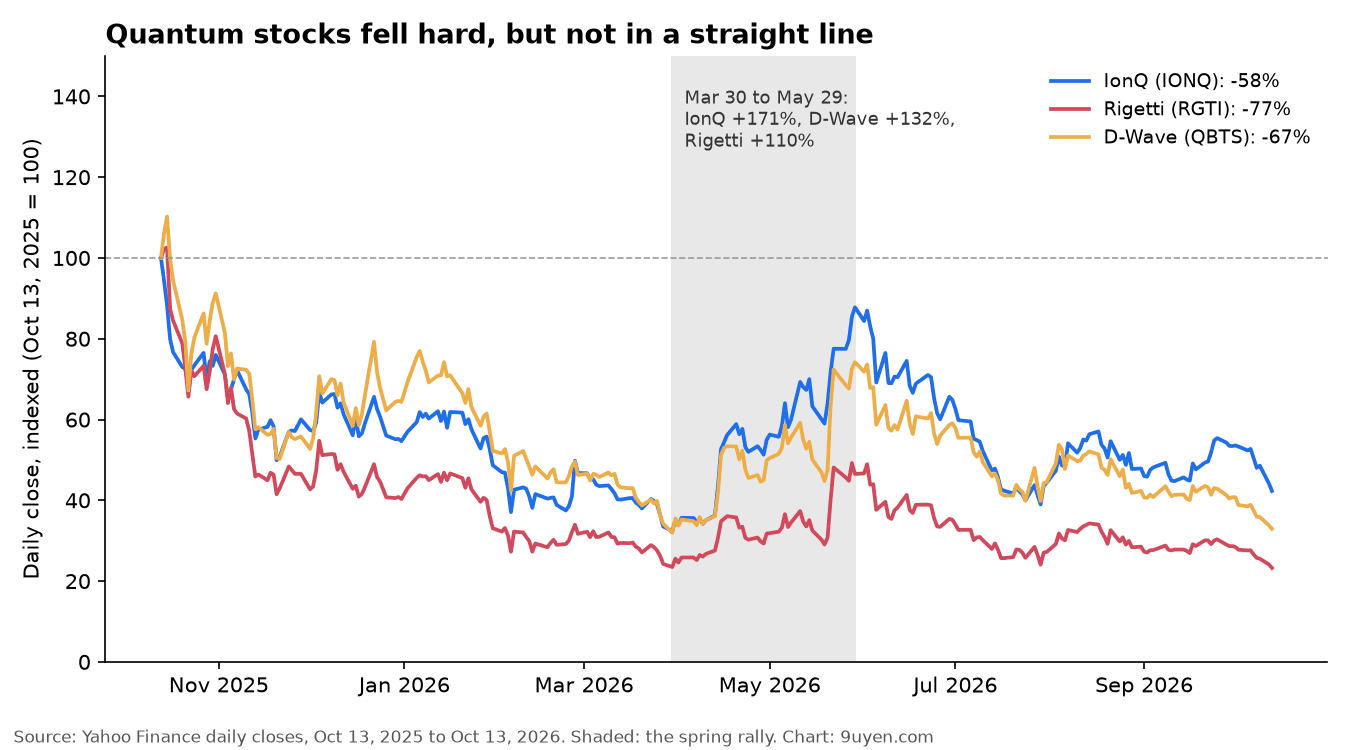
From the March 30 lows to May 29, IonQ went from $26.59 to $72.07, up 171%. D-Wave rose 132% and Rigetti 110%. A big push came on May 21, when the US Commerce Department said it had signed letters of intent for about $2 billion in CHIPS Act funding to nine quantum companies, with the government taking minority equity stakes (Motley Fool). D-Wave closed up 33% that day and Rigetti 31%.
Now do the short seller’s math. If you shorted IonQ at the March low, that two-month run cost you 171% of your position. A long can lose at most 100%. A short has no ceiling, you pay to borrow the shares, and your broker can force you out at the top. Being right in October does not help if you got margin-called in May.
Shkreli did not say when he got in, so I am not claiming that is what happened to him. But it is the most common way a correct short turns into a loss.
The stocks are still sliding. On October 12, IonQ fell about 9% after announcing an all-stock deal to buy cybersecurity company Elisity for up to $1.3 billion, and the rest of the group fell with it (24/7 Wall St.). A quantum company paying for a security business with its own shares is a strange way to argue that quantum revenue is close.
The more interesting bet: light, not qubits#
The part of the interview I keep thinking about is not the short. It is where Shkreli thinks the real speedup is.
“Every time somebody uses the word AI, I actually think of the word matmul,” he said. Matrix multiplication is what GPUs spend nearly all their time on. Multiply two 1,000 by 1,000 matrices the standard way and you need about a billion multiply-adds. He pointed to a Microsoft Research paper on an analog optical computer, published in Nature, where light does the matrix-vector math. He named photonic startups like Neurophos, which raised a $110 million Series A led by Gates Frontier in January, and Oxford spinout Lumai. He even said he and his wife might start a company there.
He is careful about it, to his credit. He admits nonlinearity and storage are unsolved, and he is still long semiconductors. His point is that it seems “insane” to plan data centers in space and new nuclear plants when you could build a faster kind of computer. Whether or not photonics gets there, that is a sharper question than “is quantum a fraud.”
Who wins AI, per Shkreli#
Asked who will over-earn while AI looks like the internet, where users capture most of the value, his answer was short: “I think it’s Meta,” for its distribution and the Muse launch. He also says he owns OpenAI exposure and bought the selloff after Dario Amodei’s essay. He is openly hostile to Amodei (“I kind of hate the guy”), so weigh those parts with that in mind.
One more piece of context the hosts did not bring up. Shkreli was sentenced to seven years for securities fraud in 2018 (AP), and in 2022 a federal judge barred him from the pharmaceutical industry for life over his Daraprim conduct (Reuters). That matters when he says AI will not produce “a single AI relevant drug in the next 10 years.”
What I take from it#
I trade onchain equities and post my book in public, so this one hits close.
- Separate the thesis from the trade. “Quantum revenue is far away” can be true for years while the stocks double on a funding headline. Size a short for the squeeze, not for the ending you expect.
- Narrative stocks trade on news, not on clock speed. The May spike came from a government letter of intent, not a technical breakthrough. Shorts in this group lose to headlines.
- The better bet is often the long on the alternative. If Shkreli is right that the real bottleneck is matmul, the upside is in whoever makes it cheaper. That is a cleaner bet than shorting the hype.
Shkreli’s own summary of the trade is the honest part: millions lost, billions in “insight.” Take the insight. Skip the leverage.
Source video: All-In Podcast, Martin Shkreli: Big Pharma’s Blind Spot, Betting Against Quantum & What Prison Taught Him