Credit: this is my take on Anthropic Rebuilt Git (yes really), a 48-minute video by Theo (t3.gg), published October 16, 2026. The company numbers and architecture come from Anthropic’s engineering post (Oct 13, updated Oct 15). Theo’s merge-speed and CI-cost stories are his own. The opinions are mine.
The short version#
Anthropic’s agents write so much code that git became the bottleneck. In May 2026 the company averaged about 2,500 merges a day. By September it was over 30,000, with a peak of 30,401 on September 9. Main-branch history alone is almost 100 GB. CI does on the order of 25 million checkouts a day. Fetch those naively and you get a counterfactual of more than 600 PB of git traffic per day.
So a team of seven built Scion, an in-house version control system, plus Antique for code review, and moved the monorepo off git in five months. Scion’s infra footprint is 200× smaller in CPU and memory than the old git mirrors. Checkouts that took minutes now take seconds.
Theo read the post on camera the day after my Digest covered the headline numbers. His cut is the useful one: this is not Anthropic being weird. It is what happens when you treat agents as first-class writers of code, and keep tooling built for humans reviewing expensive commits.
Why git stopped fitting#
Git assumes every clone is a full repo that can work offline. That design won for a reason. Anthropic’s clients are mostly agents, CI jobs, and research sandboxes that are online by definition. They needed current files or a history answer, not a durable private copy of a 100 GB monorepo.
They had already done the usual workarounds: shallow clones, sparse checkouts, promisor remotes, hundreds of internal mirrors, seed snapshots in blob storage. It bought time. Then merge rates kept rising, seeds fell further behind main, and blame and diff on partial clones got harder to keep honest.
Theo’s framing matches what I see shipping agents for small businesses: the moment agents can open and land changes faster than your review and infra can absorb them, the merge button becomes the product. He spent one late night merging 50+ PRs into T3 Code between nightly releases. A year ago that would have sounded like a joke. At Anthropic’s rate it is Tuesday.
What Scion actually changes#
Scion flips git’s assumptions:
- Clients are always online. The server is reachable; clients fetch what they need.
- Client-server asymmetry. The server creates commits, merges, rebases, answers blame and history. The client keeps a bounded cache and lays out files.
- Source control as an API. A CI job can ask for a diff or a merge base without keeping a local repo.
- Horizontally scalable, no packfiles. There is no fully materialized copy of the repo anywhere, even on the server.
- Cheap, lock-free commits. Cost scales with the size of the change, not the size of the repo. Shared refs are discouraged except for main and release branches.
- Working copies are optional and sparse. Virtualized checkouts materialize files on demand.
The unit of work is a changeset: a write-ahead-log entry listing files changed relative to the first parent, with content-addressed pointers into blob storage. Metadata lives in Spanner. File contents live in cloud storage. Blame, path history, and commit-graph indexes are derived data the server can recompute or evolve without shipping a new client.
Theo’s favorite detail: author and committer are separate fields, so you can tell who triggered the change from which agent landed it. That is the agent-native version of “who wrote this.”
The numbers that matter#
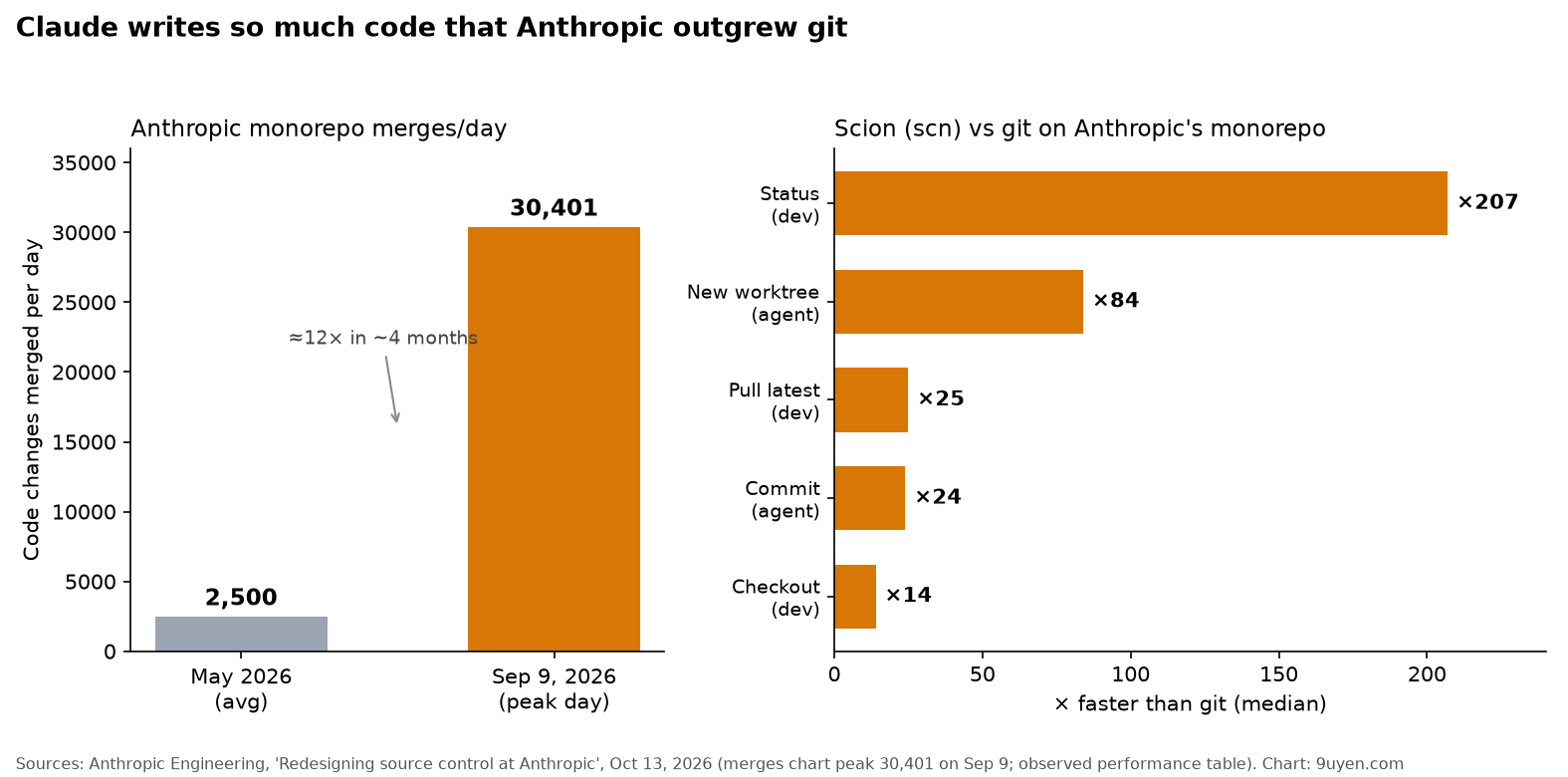
Sources: Anthropic Engineering, Redesigning source control at Anthropic, Oct 13, 2026 (merges chart and observed performance table).
From Anthropic’s own performance table on native Scion repos:
| Command | Environment | Faster than git |
|---|---|---|
| Status | Developer | ×207 |
| New worktree | Agent | ×84 |
| Pull latest | Developer | ×25 |
| Commit | Agent | ×24 |
| Checkout | Developer | ×14 |
Agent environments went from about 34 minutes of source-control time per change request on git to 3.7 minutes on Scion (×9.2), which Anthropic pegs at roughly 11,000 agent hours a day saved. CI and compute checkouts are about ×8–9 faster, with claimed savings on the order of 85,000 and 195,000 machine hours a day respectively. Cache hit rates sit above 99% at each tier.
Claude was both the cause and the construction crew. An early internal Claude Mythos Preview snapshot rewrote their git-to-Scion ingestion prototype with no further instructions and produced a version that used 20× less memory and ran 4× faster. The Scion and Antique codebases themselves have taken 12,257 changes since January, while the company brags about 30k+ merges a day across the whole monorepo. Velocity on the product that enables velocity is already dwarfed by everything else Claude is landing.
What Theo is really arguing#
The blog post is careful: Scion is not a general git replacement. It only makes sense for enormous monorepos with tens of thousands of engineers or swarms of agents. Anthropic will not open-source it or sell it. They want GitHub, GitLab, and the git community to steal the ideas: server-side RPCs, better sparse and shallow composition, negotiation that asks for specific immutable objects.
Theo pushes further. Switching cost just collapsed. He mirrored analytics into his own ClickHouse on R2 part-time because agents made the migration cheap. He rewrote TypeScript in Rust as an experiment; that compiler now runs thousands of times a day. Anthropic’s seven-person, five-month migration is the enterprise version of the same move: when the pain of staying exceeds the token cost of leaving, you leave.
The other half is cultural. Anthropic says every engineer on the Scion team would now rate Claude as a better coder than themselves, and that their job is often to tell Claude no. Agents still try to scan the commit log linearly instead of asking the review tool. Adversarial review still over-engineers. Humans review intent, not every line. Theo has been saying for a while that derisking the merge button beats adding more friction in front of it. Anthropic’s post-merge, pre-deploy testing model is that argument at company scale: they could not keep a global merge-queue lock when hundreds of changes land while tests are still running, so they invest in fast undo and agent conflict repair instead.
What I’d do with this#
I build and host AI agents for small businesses. None of my clients have a 100 GB monorepo or 25 million CI checkouts a day. Copying Scion would be cosplay. Copying the diagnosis would not.
- Measure where agents wait. Theo found almost 1,000 hours of T3 Code CI time spent on git checkouts, about $350–$600 in CPU rent for a five-person shop. If you run agents hard, pull that number before you buy another seat.
- Expose repo questions as APIs. Diffs, blame, merge bases, and “when did this land” should not require a full clone inside every sandbox. That is the portable Scion idea.
- Prefer fast revert over thicker gates. If agents can open 50 PRs in an afternoon, your bottleneck is blast radius, not typing speed. Feature flags, canaries, and one-click rollback beat a merge queue nobody can finish.
- Keep a human veto on constraints. Anthropic’s “tell Claude no” line is the job description for anyone shipping agents into production systems. Intent review scales. Line-by-line review of model output does not.
- Do not wait for Anthropic to productize this. They said they will not. Watch git forges for server-side query APIs and better sparse workflows. Until then, the win is architectural: treat source control as a service your agents call, not a folder they clone.
Git was built when code was expensive and humans were the writers. Agents flipped both. Anthropic rebuilt the stack. Most of us will not. We still have to stop pretending the old merge workflow survives contact with a fleet that never sleeps.
Source video: Theo (t3.gg), Anthropic Rebuilt Git (yes really). Primary source: Anthropic Engineering, Redesigning source control at Anthropic.